

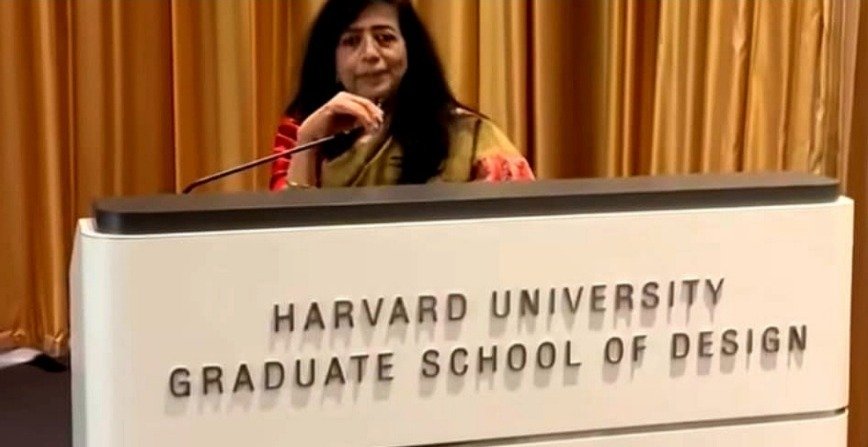
Mrs. Revathi Kamath at the podium of the Harvard University Graduate School of Design
In a resounding moment of global recognition, Mrs. Revathi Kamath — celebrated philanthropist, environmentalist, and champion of ecological restoration — stood at the podium of the Harvard University Graduate School of Design, bringing with her the wisdom of years spent reviving India’s degraded landscapes and forgotten water bodies.
Her invitation to speak at one of the world’s most prestigious academic institutions was more than a personal milestone — it was an acknowledgment of India’s quiet but powerful role in shaping the future of environmental stewardship. For an audience of distinguished faculty, researchers and students from across the globe, Mrs. Kamath’s address opened a window into a world where ecological sensitivity meets bold, pragmatic action.
Alongside her was Mr. Robert Zimmerman, Lecturer in Landscape Architecture — a collaborator whose academic rigour and openness to real-world experience made the exchange profoundly meaningful. “I come not as a theorist, but as someone who has stood knee-deep in the water of a dying lake and believed it could breathe again,” she reflected, setting the tone for an address that was as personal as it was scientific.

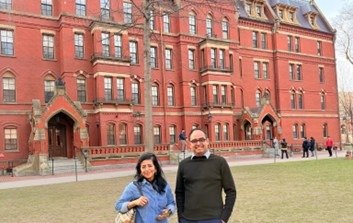
Left: In Harvard’s historic library — a moment of quiet reflection and research. Right: Mrs. Kamath at Harvard campus with a companion, the iconic red-brick buildings of Harvard Yard in the background.

Mrs. Revathi Kamath with Prof. Robert Zimmerman and participants at the Harvard Graduate School of Design — a classroom conversation that crossed borders and disciplines.
A significant portion of Mrs. Kamath’s presentation was devoted to the advanced landscaping techniques she has pioneered — approaches rooted deeply in ecological sensitivity rather than aesthetic convenience. She stressed the critical importance of aligning modern development with environmental preservation, particularly as India grapples with the dual pressures of rapid urbanization and climate disruption.
Her address shared vivid accounts of lake rejuvenation projects — practical interventions involving desiltation, bund reinforcement, native plant restoration along shorelines, and community-led monitoring systems. Lakes that had turned fetid and lifeless now teem with migratory birds, lotus blooms, and clean water that recharges the wells of surrounding neighborhoods. The Harvard audience responded with genuine curiosity and admiration — questions flowed about methodology, scalability, and the intersection of policy and practice.
Between formal engagements, Mrs. Kamath also found time to immerse herself in Harvard’s legendary library — poring over volumes with the quiet intensity of someone who remains a learner even at the height of recognition. This instinct for research and knowledge exchange has always underpinned her work — separating her environmental interventions from well-meaning but ineffective efforts.