

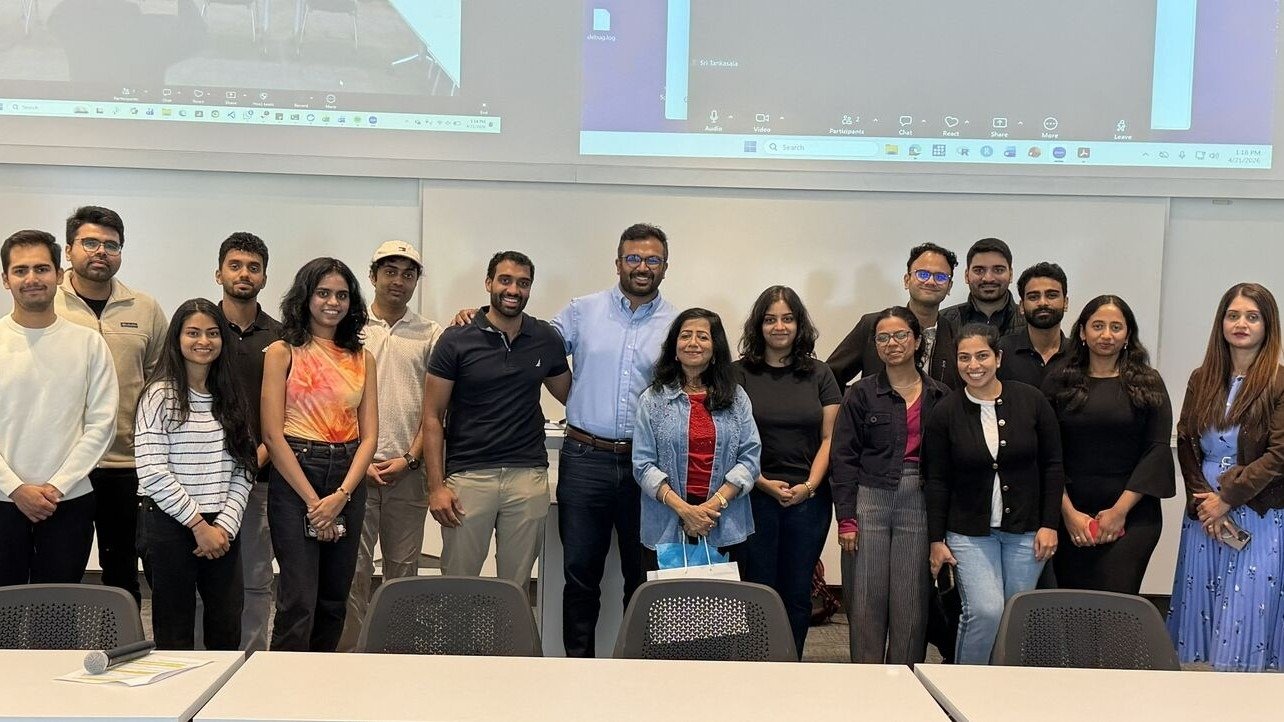
Mrs. Revathi Kamath participates in a fireside chat at the Kellogg School of Management, Northwestern University — sharing her journey from building a business to leading sustainability-driven and socially impactful initiatives across India.
Renowned philanthropist and environmentalist Mrs. Revathi Kamath recently participated in a fireside chat at the prestigious Kellogg School of Management, Northwestern University — sharing her inspiring journey and insights on sustainability and meaningful work.
Hosted by Sri Tankasala, the session brought together students and professionals for an engaging discussion. Mrs. Kamath, founder of Calyx Organic Farming and a long-time environmentalist, spoke about her evolution from building a business to leading sustainability-driven and socially impactful initiatives across India.
In a fast-paced world focused on outcomes and roles, she emphasized the importance of purpose and long-term impact. She noted that meaningful work does not follow a fixed path — it comes from staying committed to what one truly cares about, and having the conviction to pursue it.
The session served as a powerful reminder that life should be built not just as a career, but as a journey guided by purpose, values, and contribution to society. The event was supported by the Kellogg Women’s Business Association and the Indian Business Conference, with special acknowledgment to Sunil N. Kulkarni for facilitating the opportunity.
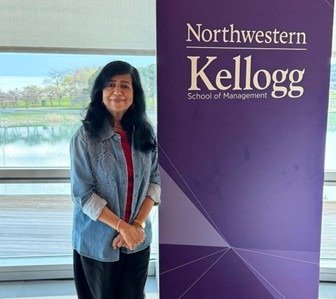
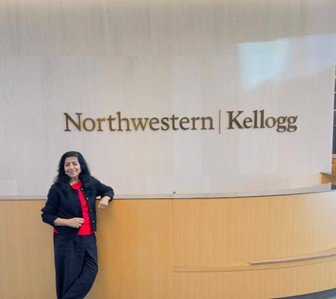
Mrs. Revathi Kamath at the Northwestern Kellogg School of Management — at the Kellogg banner (left) and at the Kellogg reception area (right), where she participated in the purpose-driven leadership fireside chat.
Rising visibility of India's grassroots environmental practitioners on the world stage.
Mrs. Kamath’s address at Harvard is, at its core, a reflection of something larger: the rising visibility of India’s grassroots environmental practitioners on the global stage. For too long, the world’s conversations about sustainability have been dominated by the perspectives of the global North — perspectives that often lack the contextual nuance of societies where ecological collapse is not a future risk, but a present reality.
In bringing her stories of lakes brought back to life, of urban forests re-seeded, of communities re-engaged with their natural heritage, Mrs. Kamath offered Harvard — and through it, the world — a model of environmental action that is rooted, responsive, and profoundly human. Her visit stands as a testament to the power of lived experience as a form of scholarship, and to India’s deepening role as a source of wisdom in the global pursuit of sustainability.
Perhaps the most intimate and impactful moment of her Harvard visit was the classroom session alongside Professor Robert Zimmerman, where she engaged directly with students from a dozen nations — young designers, architects, urban planners and environmental thinkers. Students asked about the political challenges of lake conservation, the role of women in environmental leadership, and how aesthetic design could amplify ecological outcomes. Mrs. Kamath answered each with the directness and warmth of an educator who has long understood that the future of the environment will be decided by the young.
Her involvement at Kellogg further underscored this global reach. By participating in both Harvard and Northwestern’s Kellogg School events within a single visit to the United States, she demonstrated that India’s environmental wisdom is not only relevant but urgently needed in the world’s most rigorous academic conversations.
As founder of Calyx Organic Farming and a tireless advocate for ecological restoration, Mrs. Kamath has spent decades doing the work quietly, consistently, and without expectation of recognition. The invitations from Harvard and Kellogg are the world’s acknowledgment that such work — rooted, patient, and community-driven
— is precisely the kind of leadership the planet needs now.
Her visit to Harvard’s legendary library — poring over volumes with quiet intensity — and her warm engagement with students at both institutions capture something essential about her character: even at the height of international recognition, she remains a learner, a teacher, and above all, a servant of the natural world she has devoted her life to protecting.